
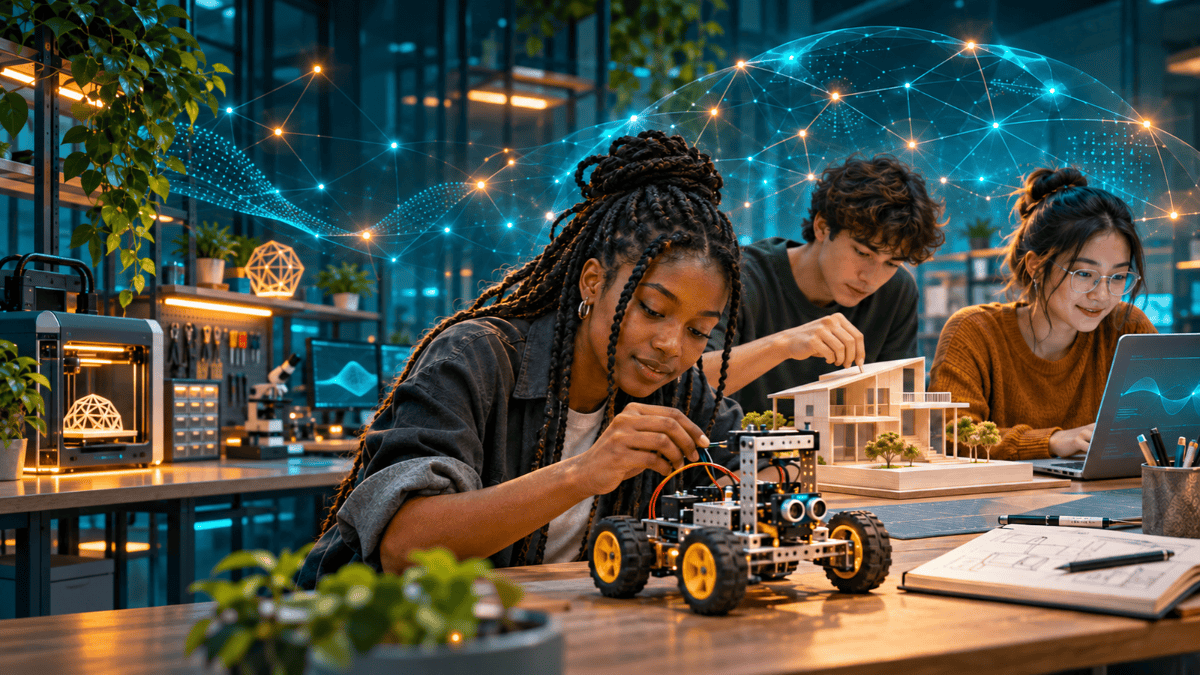
This is not an anti-college rant. Deep learning, scientific rigor, and the ability to solve hard problems still matter. But let’s be honest: families are making decisions that will shape their finances for decades while the labor market is being rewritten underneath them. The average full-time student budget? About $31,000 a year at an in-state public university. More than $65,000 at a private nonprofit one. Yes, college still delivers strong long-term returns on average. But Georgetown’s latest ROI data show something uncomfortable: institutions that predominantly award certificates and associate degrees can actually outperform bachelor’s-granting institutions in the short run. Lower cost. Faster path to earning.
But that is just the surface. Something much bigger is happening underneath.
Four out of five high school and college students in the US are already using AI for schoolwork. Only half of middle and high schools even have an AI policy. Stanford says just 6 percent of teachers think those policies are clear. AI did not wait for an invitation. It walked straight into the classroom, sat down next to our kids, and started doing the homework with them.
Knowledge is not worthless. But access to knowledge is no longer scarce. Every new AI model, every data center, every assistant chips away at the advantage that once came from simply knowing something others did not. The machine can explain the concept, write the code, translate the language, build the presentation, solve the equation. Tomorrow, it will do even more.
So why are we still forcing young people down the same path, at the same pace, to prove the same things on the same test?
Pink Floyd called out educational conformity nearly fifty years ago. Here is the harder question: have we actually changed enough for the world our kids are entering?
Here is the irony. Parents are still told the safest bet is a four-year degree. Meanwhile, the physical infrastructure behind the AI boom is desperate for people who can build, wire, cool, and maintain it. The Bureau of Labor Statistics projects 72,700 electrician openings every year through 2035, driven in part by AI and data center growth. HVAC jobs? Up 11 percent, with data centers among the drivers.
The future is not college or trades. That binary is the problem. The future is pathways. Different strengths. Different ambitions. Different ways to create value.
This is personal. I never earned a college degree. Still ended up in the C-suite. Certifications opened doors. Sales taught me that results matter more than hours. Technology taught me that the moment you stop learning, you start falling behind.
None of that means my path is the path. That is precisely the point.
What if we stopped trying to force kids to fit the system and started helping them understand themselves? What are you curious about? What are you great at? What problems do you actually enjoy solving? What kind of life do you want? What capabilities will create that value? How will you build them? How will anyone know you actually have them?
That is a radically different conversation from “What do you want to be when you grow up?”
Jobs will change. Titles will change. Technology will change. But knowing your strengths, building real capability, adapting, and creating value? That is portable.
That is the human side of the Human-plus-AI equation. Not humans trying to out-remember or out-produce machines. Humans getting much better at finding the part only they can play and learning to play it alongside machines.
If you are a parent, educator, or policymaker, try this. Ask a young person, 8, 18, or 28, what they think AI, robots, and automation will do to the work they are preparing for.
Then do the hard part. Do not correct them. Just listen.
They might understand the world they are inheriting better than the systems we built to prepare them for it.
The machines will know more. Our job is to make sure our kids can do more with what they know.



0 Comments